Sustainable Coastal Growth and Resilience 2026
IOC/OTGA/CDF/DCC-CR/SIO/RTC China:
Training Course
02 June - 11 August 2026
no location/online event
Organiser(s) & Staff
Participation
Attendance by application.
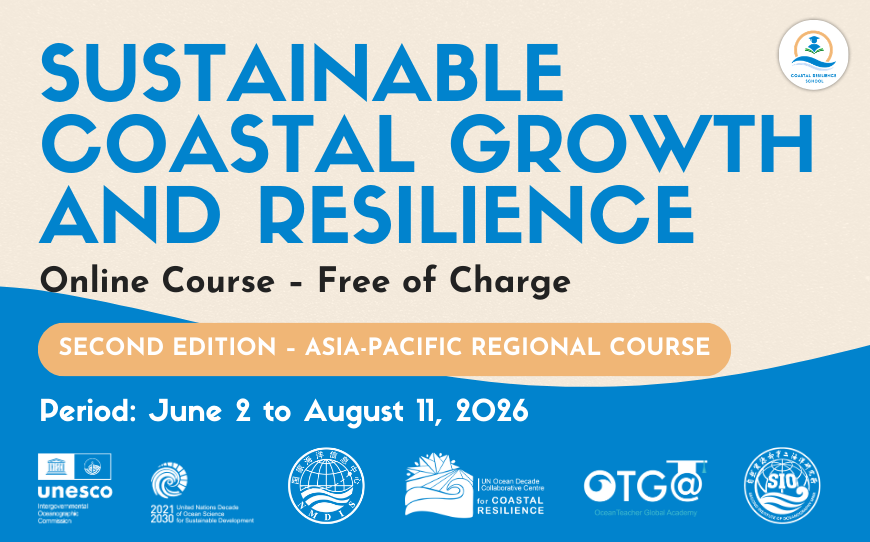
This comprehensive course provides an in-depth exploration of Coastal Resilience concepts that are key in supporting sustainable business practices and protecting communities against natural hazards and climate change-related impacts. Through five interconnected online modules and a range of interactive learning activities, participants will learn and implement the principles, technologies, and strategies needed to understand, assess, and bolster resilience within coastal regions, while emphasizing business responsibility and proactive risk management tailored to Asia-Pacific context.
Building on the success of its first edition, this course is a fully online training focused on the Asia-Pacific regional needs and priorities, jointly coordinated by the Second Institute of Oceanography of China, Ministry of Natural Resources (SIOMNR), the IOC OceanTeacher Global Academy Regional Training Centre China (National Marine Data and Information Service-China, NMDIS), the Decade Collaborative Centre for Coastal Resilience (DCC-CR), the Western Pacific Subcommission of the Intergovernmental Oceanographic Commission of UNESCO (IOC WESTPAC), Decade Capacity Development Facility (CDF), the Euro-Mediterranean Center on Climate Change (CMCC) of Italy and the CINECA Interactive Computing Services in Bologna, Italy.
Needs and priority
This training contributes to Intergovernmental Oceanographic Commission of UNESCO (IOC)'s action on enhancing the capacity of its Member States to access technology, physical infrastructure, data and information through promoting human resources development at individual and institutional levels (output 1 and 2 of IOC Capacity Development Strategy, 2023-2030); and to the UN Ocean Decade by addressing capacity development needs of partners involved in current and future actions.
This activity also contributes to the implementation of IOC Medium-term Strategy (2022-2029) and IOC WESTPAC Call to action SGOs Tokyo Statement, by facilitating initiatives to improve resilience to climate change and contribute to its mitigation.
Learning outcomes
After completing this course, participants will be able to:
- Understand the fundamentals of coastal resilience and its implications for science-based services and operations.
- Utilize operational oceanography products for hazard assessment.
- Apply enabling technologies to coastal resilience challenges.
- Develop practical resilience solutions for critical coastal infrastructure.
- Showcase innovative applied solutions through Real-World coastal resilience projects
Course content
The course is composed of five online modules:
- Overview of Coastal Resilience and its importance for Business
- Understanding coastal hazards from operational oceanography products
- Impact Assessment and risk management
- Enabling technologies for Coastal Resilience
- Solutions for Coastal Resilience
The content will be further complemented by interactive discussions, case studies, and collaborative learning activities to support knowledge exchange and practical application.
Target audience
This course is designed for early-career ocean scientists and professionals as part of their professional development and continuing education. It is especially intended for early-career ocean scientists and professionals working in coastal consulting firms, coastal managers and operators, and staff from environmental protection and civil protection agencies. Priority will be given to researchers and technical staff (such as managers and operators) from national and international institutions involved in ocean science, marine services, and ocean management in the Asia-Pacific region.
The eligible list of countries includes: Bangladesh*, Brunei Darussalam, Cambodia, China*, Cook Islands*, Democratic People's Republic of Korea*, Federated States of Micronesia, Fiji*, French Polynesia, Indonesia*, Kiribati*, Lao PDR, Malaysia*, Maldives*, Myanmar*, Nauru*, New Caledonia, Niue*, Palau*, Papua New Guinea*, Philippines*, Republic of the Marshall Islands, Samoa*, Solomon Islands*, Sri Lanka*, Thailand*, Timor-Leste*, Tonga*, Tuvalu*, Vanuatu*, Viet Nam*. (* are IOC Member States).
Pre-requisites
Educational and Professional Qualification:
-
A minimum of a Masters degree in one of the following fields: Environmental Sciences, Marine Biology, Coastal Engineering, Urban Planning, Political Science, International Affairs, Economics, Business, or a related discipline; OR a minimum of 5 years of relevant work experience in areas such as coastal management, environmental consulting, urban planning, marine conservation, or other related fields.
-
Professional affiliation with national or international infrastructure (within ocean/marine or related entities and agencies) and/or 1-5 years of relevant work experience in coastal management, environmental consulting, urban planning, marine conservation, or related fields.
Language Proficiency:
-
Demonstrated proficiency in written and spoken English.
Additional Requirements:
-
Submission of a complete application, including a Statement of Purpose.
-
Priority consideration will be given to international applicants from Least Developed Countries or Small Island Developing States in the Asia-Pacific Region. See the list of eligible countries above.
Technology requirements/computer skills:
- Basic computer skills and experience in working in a digital learning environment.
- Experience with QGIS and Python programming (Jupyter notebooks environment).
Language of instruction: English
Course Coordinators
Contributing subject experts will be available later on.
Course Format & Duration
The online modules include both self-paced activities and weekly synchronous sessions (attendance is strongly recommended and tracked, but not mandatory). The online modules comprise an estimated 70 hours of training and will be available from 2 June until 11 August, 2026.
Assessment & Certificate
This course contains self-paced automated assessments as well as written and oral assignments. A certificate will be awarded to the participants upon successful completion of:
- All modules and lessons;
- Assessments and assignments (passmark: 70%);
- Completion of a pre and post-test; and
- Completion of a feedback survey.
Application
A limited number of seats are available, to be confirmed by the organizers at a later stage, depending on the support and accessibility required to the training activities.
Applications process will run through OTGA online form. Please fill out the online application form available at this LINK. Applications open on 11 March 2026. The deadline to submit the application is 26 March 2026 (23:59 CET: Central European Time). Extended deadline: 02 April 2026 (23:59 CEST). NEW and LAST Extended deadline: 8 April 2026 (23:59 CEST).
Documents requested
Applicants will be requested to describe and/or upload the following documents and information:
- CV containing a description of education and technical background, a description of professional experience, details on the current affiliation;
- Proof of English Proficiency (Fluency); and
- A Statement of Purpose of 1000 words explaining motivation and alignment with course goals, and requirements.
Additional documentation, such as a letter of endorsement of affiliated institution and personal documents, may be requested by OTGA during the selection process.
Selection criteria
UNESCO is committed to promoting equal access principles. Applications from minority or underrepresented groups are strongly encouraged.
Selection will be based on fit to the best fit to the pre-requisites mentioned above.
Costs
Free of charge. There are no tuition fees.
Contacts
For any questions, please contact OTGA Secretariat (ioc.training@unesco.org) always using the name of the course as e-mail subject.
Cancellation policy
In the event of cancellation of the course by the OTGA or its affiliates, we will provide notification of cancellation at least 7 days prior to the course date. In the event of cancellation by the attendee, we should receive notification of cancellation at least 7 days prior to the course date.


[View an annotated printable version of this agenda]
There are 6 participants associated with Sustainable Coastal Growth and Resilience 2026 , 6 of whom are provisional .
| Name | Country |
|---|---|
| BITTONI Cecilia | Italy |
| ESPINA SANDOVAL Edwin | Italy |
| HARPHAM Quillon | United Kingdom of Great Britain and Northern Ireland |
| PINARDI Nadia | Italy |
| PRESTIANNI Annalisa | Italy |
| SCHEFFER Annette | France |
Participant Stats:
Total Invited: 6
Confirmed: 0
Not confirmed: 6
Unapproved: 0
Not-participating: 0
Rejected: 0
Label(s): OTGA Training course
Created at 15:45 on 24 Feb 2026 by Ana Carolina Mazzuco
Last Updated at 13:49 on 03 Apr 2026 by Ana Carolina Mazzuco